About me
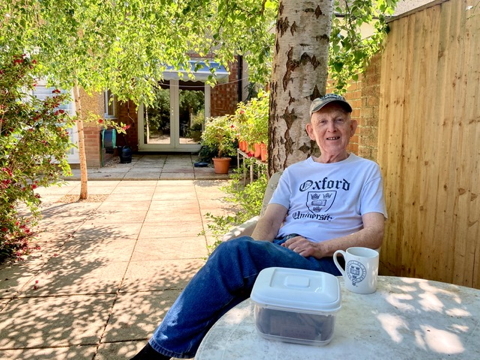
celebrating my 75th birthday in May 2020 (photo: Jim Robinson)
In brief
I'm a 78 year old gay man living in Oxford. I worked in primary and middle schools for 31 years, the last 11 as head teacher. I was also a church organist for 25 years but these days I regard religion as poisonous mumbo-jumbo. Since I retired from teaching in 1997 I've created and maintained this website.
I've been a vegetarian since the 1970s and a vegan since the 1990s. My political views are centre-left. I am very concerned about the climate crisis and the increasing hostility to LGBTQ people around the world. I want Britain to rejoin the EU, though I'm aware that this is unlikely to happen any time soon.
In my leisure time I enjoy gardening, motorcycling, reading novels (favourite authors include William Hussey and Alexis Hall), and watching films (Beautiful Thing; God's Own Country; Love, Simon etc). And I love pop music (anything from the Beatles to Taylor Swift).
My pronouns are (and always have been) he/him.
Education and training
After attending Cove Junior School in Farnborough and then Godalming Grammar School in Surrey, I did my initial teacher training from 1963 to 1966 at Westminster College, which had just moved from London into new buildings on Harcourt Hill to the west of Oxford. My two main subjects (in addition to education) were music and divinity.
It was a time of great creativity and innovation in education. Most local authorities were getting rid of the eleven plus exam and introducing comprehensive schools, and the Plowden Report on primary education was about to be published.
My second teaching practice was at Bampton CE Primary School, where child-centred education was very much in evidence. The head teacher, Mr RT (Bob) Smith, was a member of the Central Advisory Council which produced the Plowden Report.
Teaching career
My first teaching post was in Guildford, Surrey. The accommodation at St John's CE Primary School consisted of a converted house in the Farnham Road so the classrooms were very cramped, but there was a friendly family atmosphere. The head, Mrs Walford, a delightful elderly Scot, lived next door.
After my first year we moved into Queen Eleanor's CE Primary School, which had previously been a secondary school, so we now had much bigger classrooms, a good gym and even a small swimming pool in the quadrangle. I taught general subjects to (large!) classes of nine/ten year olds.
After four years I transferred to Westborough County Primary School, also in Guildford, where, in addition to my general class teaching duties, I was responsible for the teaching of music throughout the school.
In August 1972 I moved to Northampton and was appointed music teacher at Kingsthorpe CE Primary School.
A year later, the town's schools were reorganised into first, middle and upper schools and I transferred to Bective Middle School (in buildings which had been a boys' secondary school since it opened in 1934). John Allsebrook was an inspirational head to work for, a real visionary. I spent eleven happy years at Bective, teaching in a variety of capacities. For several years I was first year (now year 5) coordinator, then I specialised in teaching music and religious education, and finally I was appointed deputy head, a position I held for two years.
(John Allsebrook died in 1994. Bective Middle School was amalgamated with St George's and renamed Northampton Middle School in 1997; Bective pupils transferred to the St George's campus in 1999 and the Bective buildings were finally demolished in 2002.)
In 1985 I was appointed to my first headship at Christ Church CE Middle School in Ealing, West London. In three busy years we compiled a staff handbook which included curriculum documents and school policies, and we worked with the local authority on developing good equal opportunities practices in all aspects of the school including recruitment and selection procedures. We also piloted a staff appraisal scheme - before being required to do so by the government!
During my time in Ealing I undertook a two year part-time course at the University of London Institute of Education (ULIE), leading to the award of Diploma in Education. The areas I chose to focus on were curriculum studies and the management and administration of education in the UK.
In 1989 Clyde Chitty, then editor of Forum, invited me to join the editorial board of the journal, which had been founded by Brian Simon and Robin Pedley in 1958 to campaign for comprehensive education. Many of my articles and book reviews were originally written for Forum. I retired from the board in January 2014, but continue to contribute occasionally to the journal.
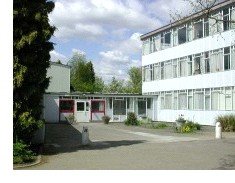 I took up my second headship at Marston Middle School Oxford (pictured) in January 1989. During the 1990s our work on bullying was featured in the local and national press and on radio and television (see my article Facing the Problem of Bullying in Schools for more details).
This was not an easy period in education. Like all schools, we had to cope with the introduction of the National Curriculum and local management (ie managing our own budget), while successive years of Tory education budget cuts resulted in the loss of some able staff.
During my time at Marston I undertook a further two year part-time course at ULIE, which resulted in the award of MA in religious education. The topics covered included the aims and history of religious education, moral and spiritual education and values education. (My Dip Ed and MA essays and my MA dissertation can all be found in the Articles section.)
I retired from full-time teaching in 1997 (at the age of 52) with very mixed feelings. I loved the job, especially the daily interactions with staff and pupils, but had become weary of the ever-increasing political interference in schools.
Since then, I have devoted my time to creating Education in the UK and hope to continue expanding the site for some years yet.
My views on education
The views which underpin my own writing are as follows:
- education should be a public service, provided by the state through democratically accountable local authorities (no privatisation, academies, free schools etc);
- all schools should be comprehensive (no selection);
- private schools and 'faith schools' should be phased out;
- teachers should receive proper training (including studies of the history, philosophy and psychology of education); and
- teaching should be recognised as a profession alongside medicine and the law.
About the site
History
I created my first website in 1998. It contained, in addition to an assortment of personal material, an education section consisting of the essays and dissertation I had written for my DipEd and MA courses at ULIE in the 1980s.
In 2001 I added the notes for a lecture on the history of education in England which I gave annually from 1998 to 2003 to groups of American teachers taking part in a summer school in Oxford. These notes became the basis of Education in the UK: a history.
By the beginning of 2004 one of my essays - about the Plowden Report - was attracting a significant number of hits, and emails began to arrive asking where copies of the report could be found. As Plowden had long been out of print and was not available online, I applied for - and was granted - a licence from HMSO to put the text of the report on the website. I retyped the first thirty pages of the 1000-page report before a friend suggested that a scanner and some OCR software might be quicker! I took her advice and, by the end of October 2004, the complete Plowden Report was online.
A series of articles about Plowden followed a year later, and in 2006 work began on the six Hadow reports. By this time it was clear that education had become the dominant - and certainly the most visited - part of the site, so on 1 May 2006 the other sections were removed and the site was named Education in England. Here's how the very first home page looked:
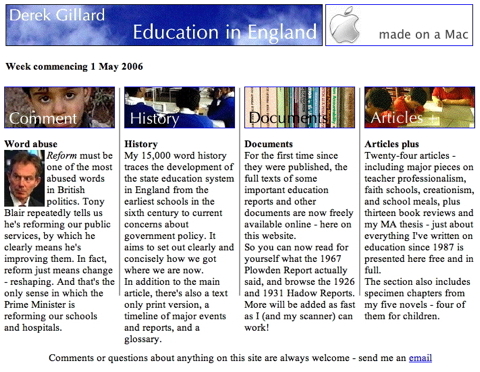 [click on the image for a larger version]
Since then, the full texts of more than 800 historic documents have been added to the site, including all the major reports on education - Bullock, Warnock, Cockcroft, Swann and Elton etc; education department publications and circulars; HMI, Ofsted and select committee reports; Official Papers; and more than 250 Acts of Parliament.
At first the site contained only material relating to schools in England (reflecting my own career and field of knowledge) but as it grew I began to add documents about education in Scotland (which has its own education system), Wales and Northern Ireland; and later on documents relating to further and higher education.
As a result, visitors began suggesting that the title Education in England, with its strapline 'a history of our schools', was now inappropriate and misleading. I agreed and, on 31 July 2023, the site was renamed Education in the UK, with a new strapline and URL.
Principles
The site is founded on the following principles:
- that historic education documents should be freely accessible to anyone who wishes to read them;
- that, as far as possible, the texts should be searchable, copiable and downloadable;
- that the main purpose of the site is the transmission of text: anything which detracts from this is to be avoided;
- that the site should be as clear and easy to use as possible.
Education in the UK is created, maintained and paid for by me as a private individual. It has no sponsors and carries no paid advertising. It is thus entirely independent of all commercial and political interests.
Education in the UK is designed for use on a desktop or laptop computer, which is how more than 85 per cent of visitors use it. It has not been optimised for use on mobile devices, but it can be accessed on them.
Education in the UK does not use cookies.
Nothing on this site was created with the use of artificial intelligence (AI) - the only intelligence involved is mine! (Incidentally, AI is an environmental disaster waiting to happen, as this Guardian piece explains.)
Sustainability
Education in the UK is created and maintained on computers and associated equipment using electricity from 100 per cent renewable sources (supplied by Ecotricity).
It is hosted by Ionos, whose environmental policy states that 'All of our data centres in the UK and Germany run entirely on electricity from renewable sources'.
Mailing list
There are currently around 570 people on the mailing list. They include teachers and students, professors and lecturers, librarians and archivists, and members of the general public with an interest in education and/or history. Those on the list are sent termly emails informing them when I've posted an update listing additions to the site.
If you'd like to be on the mailing list, just send me an email - contact details are here.
The mailing list is used solely for the above purpose: it is not shared with any other person or organisation, and I never pass on an email address without the permission of its owner.
Visitor statistics
Ionos, who host Education in the UK, provide (anonymous) weekly visitor data. This includes the number of 'unique visits' (one is recorded each time someone logs on to the site, regardless of how many pages they view), the geographical location of visitors, and the operating systems and web browsers used. Automated visits by search engines are counted separately, so these figures show only those visits made by actual human beings!
As you would expect, the number of visitors varies according to the time of the academic year: it rises during term time and falls during exam periods and the long summer vacation. The first graph below shows the number of unique visits to the site in the past six weeks; the second shows the countries with the highest visitor numbers in the past week.
The exceptionally high figures for the past few weeks have been due to large numbers of Chinese visitors: the usual figure at this time of year is around 10,000.


The following countries have appeared in the weekly top six graph in the past three years (in alphabetical order): Australia, Canada, China, France, Germany, Hong Kong SAR China, India, Ireland, Netherlands, Nigeria, Pakistan, Philippines, Romania, Russia, Singapore, South Africa, Spain, Sri Lanka, Swaziland, Sweden, Ukraine, United Kingdom, United States.