AD43-1100 The earliest schools
The Romans
There were certainly schools of some sort in Britain during the Roman occupation from AD43 to around 400. Tacitus notes that Agricola set up schools here in AD78 in order to 'romanize the sons of native chieftains' (Lawson and Silver 1973:7). And towards the end of the first century Juvenal relates that eloquent Gauls were teaching Britons to plead causes and there were discussions regarding the establishment of a Rhetoric School (Leach 1915:1).
Further evidence is 'scanty and uncertain' (Lawson and Silver 1973:7): there are virtually no surviving records of schooling in Roman Britain.
There is, however, plenty of evidence that Roman Britain had a literate culture: laws and commands of the imperial government; inscriptions on military and civic buildings, milestones, religious altars and tombstones; letters and inventories preserved on wooden tablets etc (Orme 2006:15).
And it seems reasonable to assume that the country eventually had a three-tier system of education similar to that of other Roman provinces: 'elementary learning (reading, writing, and arithmetic), grammar (correct composition and the study of literary texts), and rhetoric (the theory and practice of oratory)' (Orme 2006:16).
However, it is very unlikely that such educational provision was enjoyed by more than a tiny minority of the people:
Among the British population at large, knowledge of Latin would be confined to relatively small groups: tribal notables, officials, some craftsmen and traders in the towns, a few wealthy villa owners in the countryside, and, from the third century, the leaders of scattered, mainly urban, Christian communities. Largely unaffected by Roman ways, the great majority of country dwellers remained Celtic and illiterate. Mass education of subject peoples was never contemplated by the Romans. The empire was ruled through an educated elite (Lawson and Silver 1973:7).
Christianity reached these shores during the Roman occupation and was officially tolerated from 313. Orme says it is unlikely that Christians in Roman Britain organised their own system of education, preferring to follow the traditional practice of studying pagan Latin literature, 'using the knowledge it gave them to read the Bible and other religious works in Latin' (Orme 2006:18). In any case, 'Christianity had scarcely established itself as a public religion when Roman rule in Britain evaporated during the early fifth century' (Orme 2006:18).
And when the Romans left Britain, so did civilisation - at least for the next couple of centuries. Various gangs of Anglo-Saxon invaders showed no interest in preserving Roman civilisation and before long all that remained were the roads and monuments: 'whatever other institutions of Britain, if any, survived its conversion into England, churches and schools did not' (Leach 1915:1).
St Augustine
St Augustine arrived in England in 597 and founded two churches in Canterbury. One was Christ Church Cathedral; the other was a monastery dedicated to SS Peter and Paul (later known as St Augustine's).
Both churches were centres of literacy, since their members worshipped with books and studied religious texts, and each needed to recruit boys and men to sustain their activities in the future. The schooling of these recruits had to be organised internally because no other schools existed locally (Orme 2006:18).
Or, as AF Leach puts it, 'As there were no schools any more than there were churches in England, Augustine had to create both' (Leach 1915:3). He and his successors established two types of school: the grammar school to teach Latin to English priests, and the song school where the 'sons of gentlefolk' were trained to sing in cathedral choirs.
Thus the earliest schools in England - at least, those we know anything about - date from the arrival of St Augustine and Christianity around the end of the sixth century. It seems likely that the very first grammar school was established at Canterbury in 598, endowed - along with Augustine's church - by King Ethelbert, who was baptised in June 597:
It may be safely asserted then, that in this year, 598, as an adjunct to Christ Church Cathedral, or rather as part of it, and under the tuition of himself and the clerks who came with him and whom Ethelbert endowed, Augustine established the Grammar School which still flourishes under the name of the King's School, not from its original founder, Ethelbert, but from its re-founder, Henry VIII (Leach 1915:3).
Schools were established in other parts of Britain during the seventh and eighth centuries. In Scotland and northern England, for example, Celtic Christians established monastic communities as 'centres of missionary and therefore educational endeavour' because 'schools for the education of a native clergy were essential if Christianity was to survive' (Lawson and Silver 1973:9).
We know more about schools connected with the monasteries than about those attached to the cathedrals, because our main source of information is the Venerable Bede, the eighth century Northumbrian monk.
In his Ecclesiastical History, completed in 711, Bede writes that in 604 Augustine ordained two bishops - Mellitus at St Paul's in London and Justus at Rochester in Kent. Leach argues that it is a 'perfectly fair inference' (Leach 1915:6) that associated schools were founded at the same time. Bede suggests that another school was founded in East Anglia - probably at Dunwich - in 631 by Sigberct, who presided over the kingdom of the East English, and Bishop Felix, a Burgundian who had come to England and been consecrated by Archbishop Honorius, one of the last survivors of Augustine's original band of missionaries.
Bede also records that in 634 a song school was established at York, where James, the deacon, 'acted as master to many in church chanting after the Roman or Canterbury fashion' (quoted in Leach 1915:6). The foundation of the monastic cathedral of Lindisfarne followed in 635. Its first bishop, Aidan, 'gathered English boys for training as the Kentish missionaries had done' (Orme 2006:22).
Among other schools founded in the century after Augustine's arrival were those at Dorchester in Oxfordshire (around 634), Winchester (648), Hexham (probably 678), Malmesbury in Wiltshire (possibly founded by Aldhelm, who died Bishop of Sherborne in 709), Lichfield, Hereford and Worcester.
There were even some limited educational opportunities for girls:
Bede tells how, in about the 640s, before opportunities existed to become a nun in England, some Christian parents sent their daughters to the kingdom of the Franks (modern France) to be taught in nunneries there and to enter the religious life ... Double houses of women and men were established in England during the later seventh century and afterwards. The earliest known is that of Hartlepool ... One of its early abbesses was Hild, who later made her own foundation at Whitby in 657 which she ruled until her death in 680 (Orme 2006:24).
Most of the schools of the period, then, were connected with monasteries and cathedrals, and most of their pupils went on to become priests, monks or nuns. However, 'it is clear that bishops and monasteries gave education to other laymen who did not become clerics or monks' (Orme 2006:25). Some of these may have wished to be educated 'in order to imitate the literate noblemen of the Roman Empire and its successor states in France, Italy, and Spain' (Orme 2006:25).
Europe was also the source of many books imported into Britain. Benedict Biscop, the Northumbrian monk who founded the monastery at Monkwearmouth, brought back from Rome 'some 200 or 300 books, which thus became available to his disciple Bede' (Lawson and Silver 1973:10).
Grammar schools and song schools
Leach notes that grammar schools and song schools 'have often been confounded as if they were one school' but he argues that they were 'distinct foundations, completely differentiated in function as they were in their teaching, and generally in their government', though 'In small places they were sometimes united under one master' (Leach 1915:6-7).
Song schools 'were in essence special or professional schools for those engaged in the actual performance of the services', whereas grammar schools 'gave a general education, as much needed by the statesman, the lawyer, the civil servant, and the clerk as by the priest or cleric' (Leach 1915:7).
Augustine's concept of education derived from the Roman and Hellenistic schools of rhetoric. It comprised the seven liberal arts and sciences: the trivium, or three basic subjects, were grammar, rhetoric and logic; while the more advanced quadrivium consisted of arithmetic, geometry, music and astronomy. 'The task of the church was to adapt these subjects to Christian use' (Lawson and Silver 1973:10). They were regarded as a preparation for the study of theology, law and medicine.
However, the only subject taught systematically in the grammar schools was Latin grammar and literature, because the aim of the schools was strictly vocational: to prepare pupils for entry to the church. 'The conscious object of these early schools, attached to cathedrals and to monasteries, was to train intending priests and monks to conduct and understand the services of the Church, and to read the Bible and the writings of the Christian Fathers' (Williams 1961:128).
The most widely used Latin grammar at this time was that of Donatus, who had lived in the mid fourth century. His two famous works were the Ars Minor and the more advanced Ars Grammatica or Ars Major. The Ars Minor was in question-and-answer form, which made it suitable for learning by heart. It began (in translation):
How many are the parts of speech?
Eight.
What are they?
Noun, pronoun, verb, adverb, participle, conjunction, preposition, interjection.
What is a noun?
A part of speech that has a case, signifying a body or a thing that is proper or common.
How many features has a noun?
Six.
What are they?
Quality, comparison, gender, number, figure, and case.
(quoted in Orme 2006:28)
But 'grammar' at this time did not just mean learning about the structure of language - that limited meaning did not develop until the middle ages. Rather, it was 'a preparation for reading, especially reading aloud, and was taken to involve comprehension and commentary, so that content was inseparable' (Williams 1961:129). This caused problems for the church because, while it was essential that Latin should be understood, there were concerns that students would read a wide range of Latin literature and 'pagan' philosophy. Thus it was that Pope Gregory wrote to Bishop Desiderius in Gaul (France):
A circumstance came to our notice, which cannot be mentioned without shame, namely that you, our brother, give lessons in grammar. This news caused us such annoyance and disgust that all our joy at the good we had heard earlier was turned to sorrow and distress, since the same lips cannot sing the praises of Jove and the praises of Christ. Consider yourself how serious and shocking it is that a bishop should pursue an activity unsuitable even for a pious layman (quoted in Williams 1961:128).
Some idea of the curriculum of these early schools can be found in Bede's Ecclesiastical History. He notes that at Canterbury Theodore and Hadrian taught 'the rules of metric, astronomy and the computus as well as the works of the saints' (quoted in Williams 1961:129) and speaks of Tobias, Bishop of Rochester, who died in 726, as being 'a most learned man, for he was a pupil of Theodore and Hadrian, and so together with a knowledge of literature, ecclesiastical and general, Greek and Latin were as familiar to him as his native tongue' (quoted in Leach 1915:33).
As to the organisation of these early schools, Orme suggests that
We do not know whether religious communities possessed schoolrooms, as they had places to worship, eat, or sleep, or whether teaching went on in spaces with other functions such as the church or cloister. The daily school timetable is likely to have been subordinate to the framework of worship in church. This framework probably allowed three principal times for teaching, each a couple of hours long: two in the morning and one in the afternoon (Orme 2006:31).
In the classroom, pupils probably had 'tablets containing the alphabet and the Paternoster, tablets for making notes, and styluses for writing on them' (Orme 2006:31).
Alcuin
In the eighth century the focus of development in English schools moved from Theodore and Aldhelm in the south to Bede and Alcuin in the north.
Alcuin, a Northumbrian, was the schoolmaster in York from 776. Under his leadership the school 'set a new standard of culture' (Fisher 1936:161). Indeed, Fisher argues that:
To the influence of this robust, studious and convivial Englishman we may fairly trace the legislation which defines the educational responsibilities of the church and the episcopal and monastic schools which resulted from it (Fisher 1936:161).
Alcuin's school taught 'grammar, rhetoric, law, poetry, astronomy, natural history, arithmetic, geometry, music, and the Scriptures' (Williams 1961:129). On the face of it, this seems a pretty broad curriculum, but it should be remembered that everything was centred on the church:
Scripture was the central subject, and rhetoric teaching was mainly a study of verbal forms in the Bible. Grammar was the teaching of Latin, and versification was in the same context, though at times it extended to relate to poetry in the vernacular. Mathematics, including astronomy, was centred on the intricacies of the Church calendar, simple general exercises being an introduction to the all important 'computus' centred on the controversy about the date of Easter. Music and law were vocational studies for the services and administration of the Church, and the natural history, by contrast with the Aristotelians, was literary and anecdotal (Williams 1961:129).
Alcuin himself described the curriculum of the York school under Ethelbert, his successor as schoolmaster:
There he ... moistened thirsty hearts with divers streams of teaching and varied dews of study; busily giving to some the arts of the science of grammar (grammaticae rationis artes), pouring into others the streams of the tongues of orators; these he polished on the whet-stone of law, those he taught to sing in Æonian chant, making others play on the flute of Castaly, and run with the lyre over the hills of Parnassus. But others, the said master made to know the harmony of heaven and the sun, the labours of the moon, the five belts of the sky, the seven planets, the laws of the fixed stars, their rising and setting, the movements of the air and the sun, the earth's quake, the nature of men, cattle, birds, and beasts, the different kinds of number and various (geometrical) figures: and he gave sure return to the festival of Easter; above all, revealing the mysteries of holy writ, for he opened the abysses of the old and rude law (quoted in Leach 1915:58-59).
Alcuin left York in 782 when Charlemagne persuaded him to work for the Frankish court - to 'prescribe for the intellectual wants of a great empire fallen from civilisation to barbarism' (Fisher 1936:161).
Over the country as a whole, the influence of all this educational activity 'can have been only small' (Lawson and Silver 1973:11). By the end of the eighth century there were twenty or so episcopal and monastic schools and 'there can be no doubt that their sole purpose was to train monks and priests' (Lawson and Silver 1973:11).
However, as Lawson and Silver point out, despite mass illiteracy, Anglo-Saxon civilisation did produce art and craftsmanship of a high order, notably the Lindisfarne Gospels and items of jewellery and metalwork.
Clearly, skills of this order must have depended on long training, and presumably they could have been gained and transmitted only through some kind of apprenticeship, either of son to father within a family of craftsmen, or in permanent craft workshops attached to certain monasteries or noble households (Lawson and Silver 1973:12).
King Alfred and the Vikings
The development of education in the England was interrupted by the long series of Viking invasions which began around 866 (though Lindisfarne and Jarrow suffered earlier than this - Lindisfarne in 793 and Jarrow in 794). The Norsemen were pagans who 'loved war and women, wassail and song, pillage and slaughter' (Fisher 1936:177) and their raids caused 'immense havoc' (Fisher 1936:180). 'In two generations, monasticism and an educated clergy disappeared' (Lawson and Silver 1973:12).
The only area which successfully resisted Viking control was Wessex, where Alfred became king in 871 at the age of twenty-three.
A gloomy interval in the history of English education ensued after the death of Offa and the widespread devastation caused by the Viking invasions. When the curtain rises again, the scene has shifted from the North and the Midlands to the South, and centres in the great figure of Alfred (Leach 1915:67).
There are many stories about Alfred (the burning of the cakes being the most famous) and it is difficult to separate fact from myth. He may have been educated by St Swithun at Winchester, or at Sherborne (Leach argues that the latter is more likely). He appears to have spent several years in Rome, where he learnt Latin.
He translated Pope Gregory the Great's Pastoral Care from Latin into English and sent a copy to every cathedral in his kingdom. In the preface to this book, written around 893, he lamented the decline of learning in England which he blamed on the Danish invaders. The churches which had once been 'filled with treasures and books' had been 'all ravaged and burnt' (quoted in Leach 1915:73). There is some evidence to support these assertions: 'It has been noted that the Latin charters produced at Christ Church (Canterbury) between the 860s and 880s exhibit falling standards in their calligraphy, spelling, and drafting' (Orme 2006:34).
Alfred took 'delight in the songs and literature of his people' and showed 'concern for education' (Fisher 1936:183). Orme suggests that he endeavoured to arrest the decline in learning in three ways. First, he attempted to revive monasticism, founding a monastery for men at Athelney and one for women at Shaftesbury. (His queen also established one at Winchester). Second, he developed education in the royal household, where 'the reading of texts in Latin and English and the ability to write' (Orme 2006:35) were taught to his two sons and his daughter, as well as 'various boys gathered by the king from among his nobility, and others of lesser birth' (Orme 2006:35). Tutors - possibly both male and female - were employed, and Alfred himself taught reading. And third, he encouraged writing and reading in English as well as, or instead of, Latin.
So it was under his influence that England's schools began to be reconstructed. 'The influence and the example of Alfred in his insistence on the importance of education continued to be felt and followed in the reigns of his son and grandson, Edward the Elder and Athelstan' (Leach 1915:76).
Alfred died in 899 and was buried in Winchester. Although he had driven the Norsemen out of Winchester, Southampton, London, Oxford, and Chichester, the invasions continued for another century or so. In 1011 the Danes besieged Canterbury and captured Archbishop Elphege (or Alphege). He - and the monks who came out of the burning cathedral with him - were all murdered.
But the invaders were not all bad. In 1016 Canute, who had previously become a Christian and married the widow of his predecessor Ethelred the Unready, became king of England. According to Herman, the historian of Bury St. Edmunds who wrote towards the end of the eleventh century, Canute was concerned about the education of poor boys:
whenever he went to any famous monastery or borough he sent there at his own expense boys to be taught for the clerical or monastic order, not only those whom he found among freemen but also the cleverer of the poor, and with his own hand in kingly munificence he also in his progress made some free (quoted in Leach 1915:91-92).
Under Canute, England became part of a great Scandinavian empire until 1042.
During the tenth and eleventh centuries smaller parish churches staffed by a single priest began to be built across England. This development had educational implications: 'On the one hand parish clergy needed to be educated; on the other, once trained, they had the potential to act as teachers themselves' (Orme 2006:39).
English church leaders looked to France for advice on how to deal with this new situation. There, the Archbishop of Orleans, Theodulf, who had died in 821, had issued Capitula (rules for the clergy) which included education:
Priests, both in towns and the countryside, should hold schools, and if people wished their children to learn letters, the priests should not refuse to receive and teach them. They should decline any reward for doing so, except for what parents might voluntarily give them (Orme 2006:39).
Orme suggests that in the last three Anglo-Saxon centuries the early stages of learning 'probably continued along traditional lines' (Orme 2006:40). There is little surviving evidence, but there are a few clues in a list of books dating from the mid tenth century, written in a manuscript of Isidore's De Natura Rerum which belonged to the monastery of SS Peter and Paul (St Augustine's, Canterbury). In addition to the De Natura Rerum, the list included Donatus's Ars Minor and Ars Major, an unnamed 'gloss on Donatus', and 'Alcuin', 'probably that author's work on grammar or on orthography' (Orme 2006:40).
Two other notable figures in English education during this period were Dunstan and his pupil Ælfric of Eynsham.
Dunstan, born in 925, became Abbot of Glastonbury and later Archbishop of Canterbury. Lawson and Silver argue that it was largely Dunstan who inspired a 'renaissance of education, Latin scholarship, vernacular literature and the visual arts' (Lawson and Silver 1973:12) in the tenth century. It is also worth noting that he abhorred the widespread practice of flogging and sought to protect the boy monks at Canterbury 'from excessive chastisement' (Leach 1915:81).
Ælfric, who was schoolmaster at Cerne in the 990s, wrote three educational works: the Anglo-Latin Grammar, Glossary and Colloquy (Dialogue). Twenty-four manuscripts or fragments of his Grammar survive, 'attesting to its popularity in England up to and after the Norman Conquest' (Orme 2006:42).
Ælfric's Grammar was traditional in its form and content. Its originality lay in its use of English as the language of exposition - an originality of which he was aware. His preface anticipated criticism for writing a grammar in English, and he defended himself by saying that his book was meant only for little boys who knew nothing (Orme 2006:43).
However, it is unlikely that Ælfric was the first to use English in the classroom: 'Schoolmasters must have used it since the seventh century until their pupils were fluent enough to be taught in Latin alone' (Orme 2006:43).
The extent to which the monasteries at this time provided education for boys and youths who were not intending to become monks is not clear, though Lawson and Silver suggest that
Occasionally boys who had no intention of becoming monks may have been admitted for education, but in the social and economic conditions of the time there can have been no general demand for this (Lawson and Silver 1973:15).
There were certainly few educational opportunities for girls in this period, mainly because there were few abbeys for women. But it seems likely that there were some, because Ælfric's Grammar contains the phrase 'This nun is vigilant in teaching girls' (Orme 2006:46).
Meanwhile, where education existed at all outside the monasteries, it was individual and private rather than in schools. Around 960 King Edgar decreed that priests were expected to teach religion and crafts as a pastoral duty, and thirty years later priests were urged to maintain village schools and teach young boys without charging fees. But almost certainly, suggest Lawson and Silver,
these were utopian aspirations rather than practical objectives. Most secular priests can have had little to offer save elementary religious instruction; in the remote countryside they were probably hardly less ignorant than their parishioners (Lawson and Silver 1973:15).
On the eve of the Norman invasion, then, English society was largely 'oral, customary, illiterate, semi-barbarous' (Lawson and Silver 1973:16).
The Normans
In the century or so after 1050 developments in western Europe 'opened a new era in intellectual life and education' (Lawson and Silver 1973:18). In particular, a new approach to the works of Aristotle fascinated scholars and made the twelfth century 'one of epidemic scholastic excitement' (Lawson and Silver 1973:19). Teachers based themselves around the cathedrals, which already had schools and libraries, and this was particularly so in northern France: 'especially celebrated were the cathedral schools at Chartres, Paris, Rheims, Laon and Orleans' (Lawson and Silver 1973:19). Bologna and Salerno in Italy and Toledo in Spain also became centres of learning.
At first, England was largely unaffected by these developments, but the Norman conquest in 1066 'brought English learning and higher education into the main current of European civilization as never before in Anglo-Saxon times' (Lawson and Silver 1973:19).
The conquest, says Orme, 'resembled the coming of the Anglo-Saxons and the Viking attacks in being a political and social process that affected education' (Orme 2006:46-7). It had two main effects on education. The first and more obvious one was ethnic and linguistic:
Norman kings, bishops, and lay magnates became involved in founding or reorganising cathedrals, minsters, and monasteries in England, with consequences for the teaching that went on in such places (Orme 2006:47).
The second effect was legal and documentary:
Anglo-Saxon England had long known the charter, a grant of lands or privileges made by a king, bishop, or nobleman to clergy or laity. No charter survives from before 1066 that deals with education, but after the Conquest we begin to encounter ones that refer to schools as distinct activities or institutions (Orme 2006:47).
From around 1100, some of these charters 'indicate a more public kind of education' (Orme 2006:48), so that instead of being part of the life of a monastery, minster, or great household, education gained a more formal and public status. 'It is as if the modern school has emerged,' says Orme, 'because we can now talk of the schools of Canterbury, Dunwich, or Gloucester as being (at least to some extent) distinct activities' (Orme 2006:48). Of course, this did not happen overnight, and the process by which schooling changed from being 'an internal process of churches and households to an external one in a public freestanding institution was probably slow and complicated' (Orme 2006:48).
Nonetheless, it is clear that 'Schools multiplied as a result of the importation of books and masters from France' (Lawson and Silver 1973:19). In each of the reorganised cathedrals a scholasticus was responsible for maintaining a school, and by the second half of the twelfth century some of them - notably London, York, Lincoln and Exeter - had celebrated teachers of grammar, law and theology. 'None of these schools, however, was to survive permanently save as a grammar school' (Lawson and Silver 1973:19).
According to Leach, one of the worst effects of the Conquest was 'the foisting of the Italian adventurer Lanfranc into the See of Canterbury' (Leach 1915:96):
It was a misfortune for the school at Canterbury and elsewhere that this late converted monk became archbishop. For a determined effort to expel the monks from Canterbury and the other monastic cathedrals in England and to reinstate the seculars was frustrated by the now monkish Lanfranc. So the school, instead of being restored to its position as a part of the cathedral foundation, as at York and St. Paul's, where it was taught and governed by a resident member of the Chapter, was left to the care, necessarily intermittent, of the generally non-resident and roving archbishop, who was more often than not a busy statesman (Leach 1915:98).
Indeed, Lanfranc seems to have been remarkably uninterested in schools or schoolboys. Of the 107 pages in his 'Constitutions', which were apparently accepted as a Rule for the order of Benedictine monks in England, just two and a half pages were about the boys, and even these 'imply no learning whatever beyond knowing the psalms and services by heart' (Leach 1915:100).
Generally, however, the secular schools (ie those not connected with monasteries) began to flourish and French replaced English as the vernacular medium for teaching Latin:
The main difference caused by the Conquest was the gradual substitution of Norman for English schoolmasters and the translation by the schoolboys of Latin no longer into English but into Norman-French, which, till the reign of Edward III, was the vernacular of the upper classes in the country, of the middle classes in the towns, and of the whole cultured and clerkly class (Leach 1915:103).
Education was still largely about vocational training and most pupils were still intending monks or priests, though 'there was probably an occasional extension, and there are certainly some recorded cases of the education of young members of royal and noble families' (Williams 1961:129-130).
1100-1400 Expansion and development
The schools
By the twelfth century, educational provision had become 'a complex matter' (Orme 2006:189):
There were schools of reading, song, grammar, and higher studies. There were the internal schools of the religious houses, and the free-standing schools for the public, ranging from well-organised bodies in towns to small, private, and temporary operations in villages and parish churches (Orme 2006:189).
The schools we know most about were those in the nineteen English cities which had cathedrals. At least fourteen of these had schools - 'and it is likely that most of the others possessed them too' (Orme 2006:191).
In 1179 the Third Lateran Council decreed that every cathedral should have a schoolmaster to teach 'the clerks of that church and poor scholars freely' (quoted in Lawson and Silver 1973:20), an obligation which was extended by the Fourth Lateran Council in 1215. In England 'this seems to have been a usual practice since soon after the conquest' (Lawson and Silver 1973:21).
In the secular cathedrals the chancellor appointed a scholasticus or magister scholarum to maintain the school and granted him a licence which gave him a monopoly of grammar teaching in the city, although with the bishop's permission the chancellor could also license other schoolmasters in the city and elsewhere in the diocese.
The main purpose of these schools was to provide instruction in Latin for the lesser clergy on the cathedral staff and for the local parish clergy, but they 'almost certainly admitted fee-paying boys from the neighbourhood who wanted to learn Latin but might have no intention of becoming priests' (Lawson and Silver 1973:21).
In the monastic cathedrals the grammar school had no connection with the monastery but served the needs of the city. Here, 'responsibility for the school, including the appointment of the master, was the bishop's, since there was no chancellor' (Lawson and Silver 1973:22).
In addition to the grammar schools, cathedrals also continued to maintain song schools in which, under the direction of the precentor, a succentor and a songmaster taught choristers and younger clergy Gregorian and other liturgical chants and the reading of Latin texts. At first the boys seem to have lodged in the houses of the canons, where they received board and lodging in return for household duties, but in the later thirteenth century separate boarding houses were provided for them. In Lincoln in 1264, for example, 'the bishop assigned an income to support a common residence for twelve boys with a canon as warden' (Lawson and Silver 1973:22).
Meanwhile, outside the cathedrals, other new schools were springing up, not all of them provided by the churches: 'in every town of considerable population there was a demand for, and consequently a supply of schools' (Leach 1915:115). There were schools, for example, at Colchester, Dunwich and Warwick, whose records can be traced back to the first half of the twelfth century, while those at Derby, Northampton and Oxford have records going back to the second half (Orme 2006:192-3).
As schools opened in towns, jurisdiction over them was claimed by various patrons. Some of these were concerned 'to regulate and organise the school in the best interests of its masters and pupils' (Orme 1976:13), but others, apparently, were more interested in sharing the master's profits by charging him for permission to teach. They were eventually prevented from doing so by a canon of the third Lateran Council of 1179, endorsed at the council of London in 1200. Following this reform, benefactors 'exerted a beneficial effect upon their charges' (Orme 1976:13), sometimes providing support for poor scholars. Two types of endowed schools developed, associated with collegiate churches and with chantries.
Some of the secular schools - where the master and scholars were priests, clerks or laymen, rather than monks or friars - were open to anyone 'whom the master accepted and could pay the fees he charged' (Orme 1976:1). In the twelfth century there were such schools open to the public in at least thirty places in England, mainly in the cathedral cities and county towns.
Some schools - like those at Bedford, Christchurch and Waltham - were removed from monastic control and handed over to secular canons. Bury St. Edmund's School, for example, which had probably been founded as part of a collegiate church before Canute's time, was given an endowment at the end of the twelfth century to convert it into a 'free or partially free grammar school' (Leach 1915:119). In some cases the monasteries fought back and regained control of the schools. In Bristol, the city grammar school was transferred from the governance of the seculars to the regulars on the foundation of Keynsham Abbey in 1171 (Leach 1915:128).
According to William FitzStephen, writing around 1180, London had three 'famous schools', connected with the three principal churches. Other evidence suggests that these were St Paul's cathedral, the nearby collegiate church of St Martin-le-Grand and the church of St Mary-le-Bow. 'FitzStephen vaguely refers to other schools, specially allowed because of the reputations of their teachers - presumably private schoolmasters unattached to any particular churches' (Lawson and Silver 1973:23).
In the thirteenth century there are records of schools at King's Lynn, Leicester, Lewes, Ludlow, Shrewsbury, Cambridge, Dover, Guildford, Lancaster, Nottingham, Stamford and Taunton. And for the first time, there is also evidence of schools in smaller towns. Thirteenth-century Yorkshire, for example, had, in addition to the cathedral school at York, schools at Beverley, Guisborough, Hedon, Helmsley, Malton, Pontefract, and Wakefield (Orme 2006:193). Village schools, however, did not begin to appear until around 1500.
By the end of the fourteenth century schools were being endowed by wealthy benefactors so that the master could teach without charging fees. Endowed schools of this kind became known as 'free schools'.
In addition to these endowed schools, there were also private secular schools, some in the almonries of the great monasteries, some in the households of the wealthy. 'The education provided in these private schools may have been as good as or better than that available to the public, but the numbers of scholars involved were much smaller, usually less than twenty or a dozen' (Orme 1976:1). Some of the religious orders also had 'cloister schools' where monks and friars taught their members a range of subjects from grammar to advanced theology.
The Black Death of 1348-9 (and further outbreaks in later years) killed between a quarter and a third of the population. The clergy were particularly badly affected, and this resulted in a shortage of teachers which lasted well into the next century. The custom of appointing teachers for three years at a time was dropped. In 1368 the York chapter explained that this was 'because of the brevity of life and the scarcity of masters of arts since the pestilence' (quoted in Lawson and Silver 1973:43). To make up for the shortage of clergy, new grammar schools were established. These were usually attached to an ecclesiastical institution to ensure their permanence, 'for in turbulent and lawless times only the church seemed safe' (Lawson and Silver 1973:43).
In summing up the provision of schools in medieval England, Nicholas Orme warns that the picture we have is 'disappointingly incomplete':
Hardly a single school can provide satisfactory evidence for its continuity over the whole of our period. ... No regular procedures existed for recording schools in medieval times, and the historian has to depend on their casual appearance in documents primarily concerned with other matters. ... It would be most unwise to equate the facilities for education in medieval England with the relatively small number of schools of which we are aware today (Orme 1976:6).
Nonetheless, it is clear that a growing dependence on the use of written documents was 'an outstanding feature of the twelfth and thirteenth centuries' and that this could 'scarcely have taken place without a significant increase in schooling' (Lawson and Silver 1973:25).
The schoolmaster
Lawson and Silver suggest that 'In the country at large most of the teaching obtainable was probably provided by individuals, not by permanently established institutions, and was therefore casual, sporadic and unorganized' (Lawson and Silver 1973:23).
Parish priests often undertook the task of teaching, if they were sufficiently literate themselves. In 1200 they were ordered by a synod at Westminster 'to keep schools in their towns and teach little boys gratis' (quoted in Lawson and Silver 1973:24). Shortly after this the prior of Canons Ashby in Northamptonshire observed that when he had been a youth 'there were scarcely any masters ... whose teaching was not mercenary' but that now 'there are many who teach without a fee. Many are the founts ... ever open to those wishing to draw from them' (quoted in Lawson and Silver 1973:24).
The job description of a medieval schoolmaster was fairly basic: he needed 'sufficient knowledge of grammar and an honest reputation. Founders of schools rarely stipulated anything else ... Very few schools in England required their masters to be graduates' (Orme 1976:19).
So the schoolmaster's status 'was rather a humble one' (Orme 1976:20). Teaching was often left to to junior clerks, and some notable English schools in the fourteenth century - Lincoln, Oxford and York - restricted their schoolmasters to short terms of three or five years. No ambitious man would have wasted his time teaching: 'Fame and preferment lay through law and administration' (Orme 1976:20). Most schools, even in the cities, had a single master. Gloucester had an undermaster in 1400 but 'ushers' (deputies) did not appear widely until the early sixteenth century.
Organisation and curriculum
Most boys started school around the age of seven and university around the age of fourteen. But adults were taught in the same classes as the boys - age seems to have mattered little. This was characteristic of medieval society: 'When clocks and calendars were rare, time was uncertain and of small account; people were hardly conscious of age' (Lawson and Silver 1973:49).
Few of the boys who attended grammar schools would have come from poor families. In addition to the expense of lodgings for them while at school, there were fees to be paid to the master. Most would have been the sons of freeholders, tradesmen, officials or gentlemen.
Discipline in the schools was harsh, and punishments reflected the crude and violent nature of
medieval society: 'pain and physical punishment (amply justified by biblical authority) were regarded as indispensable for guiding the young to virtue' (Lawson and Silver 1973:49).
Leach argues that medieval England's schools 'gave no education fit to be called a liberal education' (Leach 1915:136), and he quotes Cambridge University historian Bass Mullinger, who, in his 1895 book Social England, wrote:
We hear but little concerning schoolboy life in medieval times, but that little is generally unfavourable. ... The average attainments were limited to reading and writing, to which in the cathedral schools there were added chanting and an elementary knowledge of Latin (quoted in Leach 1915:136).
Orme identifies three stages in the medieval curriculum, all involving the study of Latin:
Children began by mastering the alphabet, then practised how to read Latin words and pronounce them. ... Reading and 'song', meaning plainsong, formed the first stage of the curriculum. Next came the study of grammar. Its students learnt how words were inflected and tried to memorise their meanings. They practised prose and verse composition and were taught how to speak the language boldly and fluently. They studied literary texts and were introduced to the principles of literary criticism. Those who had mastered Latin thoroughly were able, if they wished and could afford it, to go into higher studies: the arts course, medicine, civil and canon law, and theology. These subjects, all of which were taught and studied in Latin, constituted the third and highest grade of medieval education (Orme 1976:2).
Books and writing materials were scarce and expensive so the teaching was entirely oral: 'learning depended on dictation, repetition and feats of memory' (Lawson and Silver 1973:48). English gradually replaced French as the vernacular in the schoolroom during the fourteenth century.
There was some overlapping between the courses in the schools and universities:
Boys studied grammar before going to university, but in so doing they were introduced to some of the principles of logic which was properly a university subject. On the other hand you could also study grammar at Oxford from scratch, and the university arts course included a certain amount of grammar of an advanced kind. The demarcation between school and university was thus obscured, and this had its verbal equivalent since the universities were generally known as 'the schools' in medieval times, and their undergraduates as 'scholars'. You 'went to school' at Oxford and attended the 'schools' or lecture rooms of the masters there. It is all very confusing for the unwary (Orme 1976:3-4).
While education was still seen as a Christian enterprise, the concept of a liberal education - a preparation for the specialised study of law, medicine, or theology - began to develop:
The concept of the Seven Liberal Arts (the trivium of grammar, rhetoric, and dialectic, the quadrivium of music, arithmetic, geometry, and astronomy) goes back to at least the fifth century, but it was only now that it began to be realised with any adequacy, as new material from classical learning, and new attitudes towards it, flowed in (Williams 1961:130).
Literacy
Attempts have often been made to assess literacy levels at various times in history. Before the nineteenth century this is not easy because there is so little reliable evidence. Writing - usually one's name - is the only available measure, and 'this does not necessarily imply ability to write much else, though it is assumed to imply ability to read at some level' (Lawson and Silver 1973:34).
Lawson and Silver examine literacy levels during this period (1100-1400) among four groups of the population - peasants, knights, clergy and townsmen - bearing in mind that although French became the vernacular of the court and the aristocracy after the Norman conquest, Latin was still widely used in documents relating to ecclesiastical and secular administration.
They suggest that the illiteracy of the peasants - the great mass of the population - 'is not in question' (Lawson and Silver 1973:34). Neither were the Anglo-Norman barons and knights - those who fought - much more literate than the peasantry.
Even among the clergy, literacy was very unevenly spread:
The higher learning of cathedral schools and universities soon created a gulf between the clerical aristocracy of bishops, canons and well-to-do rectors, and the clerical proletariat of stipendiary curates and chaplains who were the casual work force of the church (Lawson and Silver 1973:36).
It is hardly surprising that the parish clergy were lacking in education, since many of them were unfree peasants by birth, and ordination was one of the few lawful ways they could escape serfdom. Until 1406 a bondsman was only permitted to send his son to school if he intended to become a priest.
Meanwhile, the townsmen - those who manufactured and traded - grew in importance during this period as commerce increased. For them, illiteracy would have been 'incompatible with financial dealings on any large scale' (Lawson and Silver 1973:38).
As to royalty, the first two Norman kings were illiterate, but 'Henry II was the most educated king since Alfred; from his time onwards kings were probably more or less literate' (Lawson and Silver 1973:35).
Lawson and Silver conclude that around three per cent of the population is likely to have been literate in 1300. Most of them would have been in London and the larger towns, in colleges, friaries and monasteries. Nonetheless, 'over the past two centuries literacy and education had certainly grown in extent and also become more secularized: England was far more civilized as a result' (Lawson and Silver 1973:39).
But the vast majority of the people still lived
in mental confinement, limited by their own experiences in a small circumscribed world ruled by village custom and popularized religion. Hence their inertia, their credulity and fear-ridden superstitions, which to a large extent explain the slow pace of social change (Lawson and Silver 1973:39).
The universities
Origins
Oxford university had its origins in the twelfth century; Cambridge in the thirteenth.
There is evidence of some teaching in Oxford as early as 1096, and of schools around the parish church of St Mary from the early 1100s.
There was more rapid development after 1167, when Henry II banned English students from attending the University of Paris. In 1188 the historian Gerald of Wales visited Oxford to speak to the dons and two years later Emo of Friesland became the university's first overseas student.
By around 1200, Oxford was becoming, like Paris and Bologna, 'one of the great educational centres of Western Europe: a studium generale with an organized gild or universitas of masters and scholars' (Lawson and Silver 1973:20). In 1201, the university was led by a magister scholarum Oxonie and in 1214 he was given the title of Chancellor. The masters were recognised as a universitas or corporation in 1231.
The university
was essentially a community of masters and scholars, and it remained no more than that for over 100 years. The fees which each student paid to the master who taught him were its financial basis. It had no property of its own. Books were hired from copyists; for assemblies and disputations the church of St Mary was used; and for schools or lecture halls the masters rented rooms in houses in the neighbouring streets and lanes (Lawson and Silver 1973:25).
The close proximity of the townspeople and the students - 'town and gown' - led to trouble. There were 'unending grounds for friction - rents, prices, debts, disputed rights and immunities' (Lawson and Silver 1973:25), which sometimes ended in rioting. 'Teaching and learning went on amidst quarrels and brawls' (Lawson and Silver 1973:25-6).
Some Oxford scholars became tired of the hostility of the townspeople and in 1209 they moved to Cambridge. At first they lived in lodgings, then houses were hired as hostels with a master in charge of the students. By 1226 the scholars had formed themselves into an organisation, represented by a Chancellor.
Meanwhile, Oxford tried to alleviate the problems with the townspeople by setting up primitive halls of residence, which later became the first Oxford colleges. University College (initially intended for just four masters studying theology) was established in 1249, Balliol (for sixteen scholars) in 1260 and Merton (for twenty scholars) in 1264. At Cambridge, the earliest college was Peterhouse, founded by the Bishop of Ely in 1284. 'Originally small, unimportant and hardly noticeable in the university as a whole, the colleges later became paramount' (Lawson and Silver 1973:30).
(A third university - at Northampton - was granted a Royal Charter by Henry III in 1261, but it lasted only four years. In 1265 bishops warned that the new university posed a threat to that of Oxford, and Henry was persuaded to issue a Royal Decree banning the establishment of a university in Northampton. That Decree remained in force until 2005, when it was repealed by the Privy Council, allowing the town's University College to gain university status. For more on the history of Northampton University see the Wikipedia page on The University of Northampton.)
Oxford's university quickly became the country's 'principal source of learning and higher education' (Lawson and Silver 1973:26) and as such it could depend on the support of the king in any quarrel with the townspeople: 'every reference of a dispute to the Crown invariably ended in the confirmation and extension of the university's privileges and the humiliation of the burgesses' (Lawson and Silver 1973:26).
By 1300 both universities were 'well established and playing a nationally important role' (Lawson and Silver 1973:30). Oxford had 1,500 students; Cambridge, which remained smaller until the mid-fifteenth century, had around 500.
At Oxford the university's first premises were a small house and library attached to St Mary's church in 1320. This was 'an investment so small that it hardly committed the masters and scholars to staying in the town permanently' (Lawson and Silver 1973:52).
It was the growing number of colleges that rooted Oxford and Cambridge in their respective cities. Ten were founded in just thirty-six years: Exeter (1316), Oriel (1324) and Queen's (1341) at Oxford; King's Hall (1317), Michaelhouse (1324), Clare (1326), Pembroke (1347), Gonville (1347), Trinity Hall (1350) and Corpus Christi (1352) at Cambridge.
Like their late thirteenth century forerunners, the colleges
were small, self-perpetuating communities of about a dozen scholars or fellows, who constituted a permanent corporate body ruled by one of their own number whom they chose themselves, all sharing a common life of study and prayer supported by the income from property given by the founder (Lawson and Silver 1973:52).
They were 'external to the university' but their advantages made them attractive to able men and their 'corporate attitudes and interests could carry weight in academic controversy' (Lawson and Silver 1973:53).
By around 1360 the six Oxford colleges had about seventy fellows; the eight Cambridge colleges perhaps eighty.
Most of the students were boys aged from fourteen or fifteen who had had some preliminary grounding in grammar. They were typically the sons of knights or yeomen, successful merchants, tradesmen or artisans. There were probably also a few promising youngsters from poorer backgrounds who had been noticed by a local abbot or archdeacon.
Curriculum and organisation
The universities at this time were centres of professional training, preparing men for careers as teachers, preachers, lawyers, officials and administrators. They were not concerned with the pursuit of knowledge for its own sake or with research. Such things were intellectual luxuries which society in general and students individually could not afford.
In any case, in orthodox medieval thought the truth was not to be discovered by free inquiry and experiment: it existed in the Scriptures, the Fathers, Aristotle and other texts of unimpeachable authority, and it had to be extracted and interpreted by logic and reason in lectures, questionings and disputations (Lawson and Silver 1973:31).
Lawson and Silver suggest that, intellectually, the great task of the thirteenth-century universities
was the assimilation of the newly discovered body of Graeco-Arabic science, medicine and philosophy, and in particular the integrating and harmonizing of the new Aristotelian metaphysics with the revealed truths of Christianity. The process went on unevenly and eclectically and in a fervour of controversy. Aristotelianism found its stronghold in the arts faculty, where reason and logic sometimes went beyond what theology allowed and led to ecclesiastical intervention and censure (Lawson and Silver 1973:28-9).
The seven liberal arts, dating from the fifth century, formed the basis of the universities' teaching. The trivium of grammar, logic and rhetoric led to the degree of bachelor; the quadrivium of arithmetic, music, geometry and astronomy led to the degree of master.
In order to avoid abuse of the royal privileges which were conferred on scholars, in 1231 Henry III decreed that all students at Oxford and Cambridge were to have their names entered on the roll (matricula) of a licensed master or regent. The university itself later assumed this duty. Stages in a scholar's progress were marked by 'graduation' ceremonies, with the grades differentiated by variations in the gown, hood and cap. Reminders of these terms and practices survive to this day.
There were no professors: the teaching was conducted by masters who had themselves undertaken the course and who had been approved or 'licensed' by their colleagues (the universitas). Thus the role of teachers began to be formalised: they were licensed rather than simply appointed, and university degrees became licences to teach.
A student who became a master of arts was obliged to lecture in the schools for two years as a 'necessary regent'. 'Teaching and administration were thus largely in the hands of a succession of relatively young, recently graduated masters' (Lawson and Silver 1973:27-8).
Some masters stayed on as a regent after the obligatory two years and made a living from their students' fees, but most left and found other employment. A few studied for a higher professional qualification in divinity, law or medicine.
At Oxford four more years led to the bachelor's degree in civil law, six to the doctor's degree in medicine, seven to the bachelor's degree in theology, and after that two more to the doctorate. Not surprisingly, these degrees were relatively rare (Lawson and Silver 1973:28).
Discipline
The universities were not just places of serious teaching and learning: they were also 'centres of vigorous adolescent life' (Lawson and Silver 1973:31). Students were subject to few restraints and would have learned not just from the 'methodical procedures of the schools', but also from 'their friendships and love affairs, by talk, contention and violence in the streets, lodging-houses and taverns of the town' (Lawson and Silver 1973:31).
Hostility between town and gown remained a problem in Oxford, with youthful exuberance among students sometimes becoming excessive. In 1334 some masters and scholars, tired of the continuing violence, left for Stamford. But the king ordered them to return and 'enlarged the university's franchises at the town's expense' (Lawson and Silver 1973:51). The following year saw looting and burning and a number of deaths, but still the crown took the side of the scholars:
their privileges were extended and the town's ultimate humiliation was kept fresh by an annual penance of the mayor, bailiffs and sixty burgesses in the university church. The university's ascendancy was complete and lasted with mutual ill will until the nineteenth century (Lawson and Silver 1973:51-2).
Cambridge also suffered constant friction and occasional violence which culminated in the great riot of 1381, during which some of the university's records were burned. 'Until Victorian times, town and gown cohabited with no more affection than at Oxford' (Lawson and Silver 1973:52).
Nonetheless, by the fourteenth century the universities were making an increasingly important contribution to national life.
They stood at the apex of the educational system, such as it was, and although learning still flourished in other places, like the cathedrals and some greater monasteries, it was the universities that nourished it. University-trained men came to hold the highest offices in the administration of church and state (Lawson and Silver 1973:54).
Fourteenth century problems
Unfortunately, the middle years of the fourteenth century brought problems for the universities.
First, the series of wars with France (the so-called Hundred Years War), which began in 1337, resulted in students leaving the schools for military service.
And second, the Black Death of 1348-9 (and further outbreaks in later years) caused manpower problems for both the universities and the schools. At Oxford no colleges were founded between Queen's in 1340 and New College in 1379. At Cambridge no new colleges were created between 1352, when Corpus Christi College was founded 'expressly to repair the ravages created by the plague of 1349' (Leach 1915:201), and 1439, when God's House (now Christ's College) was founded to restore the supply of grammar masters, the shortage of which had caused dozens of schools to close. The epidemics also severely reduced the number of scholars.
Meanwhile, the church was becoming anxious to maintain its control over the universities, partly to combat heresy, and partly because 'at a time when the influence of the monastic order was declining and the powers of common lawyers presented a new challenge, it was particularly important to extend opportunities for secular clerks to qualify in canon and civil law' (Simon 1966:40).
Wycliffe and the Lollards
The philosopher and theologian John Wycliffe (1330-1384) was a severe critic of the Roman Catholic Church. He and his followers, known as Lollards, were regarded as heretics at the time, though many of their ideas were taken up a century later during the Reformation.
Wycliffe and the Lollards, says Orme, illustrate 'the antithesis between ordinary people valuing literacy and authorities anxious to control education' (Orme 2006:222). They advocated reading and writing in English and produced many controversial leaflets. Wycliffe's English translation of the Latin Bible was published in 1382.
Their concerns about education related more to adults than to children. So when, in the 1390s, they proposed financing education and welfare from the property of bishops and monasteries, their aim was the foundation of universities and almshouses rather than schools.
The church viewed Lollardy as a threat to both religion and education. In 1408 Archbishop of Canterbury Thomas Arundel issued 'the only general legislation about schools made by the English Church in the fourteenth and fifteenth centuries' (Orme 2006:222). Schoolmasters were ordered 'not to teach their pupils anything about the faith or the sacraments that was against the determination of the Church, and not to allow their pupils to hold disputations concerning matters of faith' (Orme 2006:222).
The extent to which the order was enforced is unclear, says Orme. But 'the fact of its production is significant' (Orme 2006:222):
Just as the Lollards anticipated the Reformation in some respects, so they stimulated the Church authorities to address the teaching of children in a way that presaged what would happen in the sixteenth century (Orme 2006:222).
1400-1500 Growing demand for education
The schools
The hundred years from around 1350 to 1450 were not easy ones: the plagues and the long wars with France resulted in depopulation, scarcity of labour and diminished trade; all of which conspired to damage society and weaken the economy. They also helped to produce an 'educational depression' (Lawson and Silver 1973:46), which was exacerbated by the preoccupation of the universities with logic and philosophy and their neglect of grammar. This had the effect of depleting still further the supply of competent schoolmasters.
There were many complaints about the decay of grammar teaching. William Byngham, a London rector, for example, claimed in 1439 that he knew of seventy schools that were moribund for want of teachers east of a line 'from Hampton to Coventry and so forth no farther north than Ripon' (quoted in Lawson and Silver 1973:47). And in 1447 a petition to parliament calling for more schools in London mentioned 'the great number of grammar schools that sometime were in divers parts of this realm besides those that were in London and how few be in these days' (quoted in Lawson and Silver 1973:47).
To try to improve the situation, in 1439 Byngham founded - with Henry VI's encouragement - God's-house at Cambridge as a college specifically for teaching grammar and producing qualified schoolmasters. 'After taking their degrees, its members were obliged to accept any grammar-school appointment offered them at a sufficient salary' (Lawson and Silver 1973:47). Despite this, in 1464 Oxford university complained that 'grammar, the basis of all education, had gone into exile and deserted this realm' (quoted in Lawson and Silver 1973:47).
Nonetheless, fifteenth century England now had a wide range of different types of school. Most of these served their local area - few boys travelled far from home to receive their education - though the grammar schools of Oxford 'probably attracted many boys from all over England who wanted and could afford a better education than the local schools provided' (Orme 1976:11).
Literacy spread as English replaced French:
From the late fourteenth century, English gained social respectability with the gradual recognition of its suitability for business and literature, and its use in writing rapidly became general, completely displacing French by about the 1420s. Thus an educated laity could develop in a way that was impossible so long as literacy meant familiarity with Latin (Lawson and Silver 1973:80-1).
And there was certainly growing interest in education among the laity.
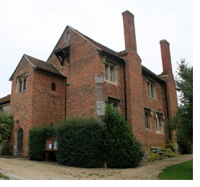 In the Oxfordshire village of Ewelme, for example, Alice Chaucer (granddaughter of Geoffrey Chaucer) and her husband William de la Pole were granted a licence by Henry VI in 1437 to create a new foundation, God's House, which included almshouses, a school and a church.
Founded as a medieval grammar school, Ewelme school (pictured) endured the upheavals of the Tudor period, almost fell into disuse during the eighteenth century, and was threatened with closure in the 1950s. Today it is a Church of England Voluntary Aided Primary School and can claim to be the oldest continuously functioning school in the country (Reg Little The Oxford Times 5 February 2015).
A few miles away, in Oxford itself, the great schoolmaster William Waynflete founded Magdalen College in 1458, 'and attached to it not one but two schools, one at his native place, Wainfleet, in Lincolnshire, in 1459, the other Magdalen College School, by the gates of the college at Oxford' (Leach 1915:270). At the latter he provided for a master to be paid £10 a year and an usher (his deputy) £5, 'to teach all comers freely and gratis without exaction of anything' (quoted in Leach 1915:270).
Guilds were an important feature of the social and religious life of the time and their numbers increased from the 1350s onwards. They were 'fraternities devoted to honouring particular saints or festivals, coupled with the performance of different kinds of good works' (Lawson and Silver 1973:44) which sometimes included maintaining a school. In Oxfordshire, for example, two Trinity guilds were granted licences at Deddington in 1446, and at Chipping Norton in 1451.
Other schools were founded in association with hospitals or almshouses, sharing the same endowment and premises:
In 1422 Archbishop Chichele established a college at Higham Ferrers, his birthplace in Northamptonshire, and incorporated in it an almshouse and an existing grammar school. One of the biggest of all hospitals, St Leonard's at York, included on its establishment two schoolmasters (Lawson and Silver 1973:44).
Many of the endowed schools of this period provided free education, and some were aimed specifically at the less well off. Winchester College, for example, was 'meant for children with incomes of less than five marks' (Orme 2006:240). However, endowed schools tended to attract 'the respectable and comfortably off', so Winchester 'soon became dominated by the sons of gentlemen, merchants, yeoman farmers, or shopkeepers' (Orme 2006:240).
As to the very poor, Orme suggests that they
were not ineligible for free education, but they needed a good deal of encouragement or ambition to use it. It took determination to buy school clothes and materials, give up a boy's lost wages, and cope with the social tensions that might arise when he mixed with his betters (Orme 2006:240).
As the fifteenth century neared its end and the sixteenth began, rising prosperity, a more settled political climate and a growing population resulted in greater investment in education through private philanthropy. Successful merchants became increasingly aware of the value of education and founded or endowed schools in their home towns, often in connection with chantries or guilds. 'Sometimes these were new schools, sometimes existing schools which became free since the endowment provided the master's stipend' (Lawson and Silver 1973:50).
In Scotland all the principal towns had grammar schools teaching Latin, and 'lecture-schools' in which children were instructed to read the Scots tongue. In 1496, a statute required all barons and freeholders of substance to 'put their eldest sons and heirs to schools from the age of six or nine' (quoted in Dickson 1921:1496). They were to remain at the grammar schools until they were competent in Latin and then spend three years at the schools of art and law. A fine of £20 - a large sum at the time - was imposed on those who failed to comply.
This seems to be the beginning of compulsory education in Scotland, but there is nothing here to indicate that the other classes of the nation were receiving attention with regard to education (Dickson 1921:1496).
Chantry schools
Benefactions to monasteries had dwindled in the late 14th century, so wealthy benefactors or guilds now began to establish 'chantries', each with its own priest, to celebrate Masses for the repose of the benefactors' souls, and, in many cases, to conduct a school. Orme argues that 'The origin and early diffusion of chantry schools is ... a mystery' (Orme 1976:16).
The first of the chantry schools was probably the grammar school at Wotton-under-Edge in Gloucestershire, founded in 1384 by Katharine Lady Berkeley.
Katherine issued a charter and a code of statutes. She endowed her school with land and rent which produced an income of around £17 a year by the sixteenth century. This supported a schoolmaster and 'two poor scholars receiving free board, lodging, and education' (Orme 2006:229). The master, who was to be a priest, had two duties: he was to 'sing daily masses in Wotton parish church for the souls of the foundress and her relatives, and to teach grammar gratis to the two scholars and to anyone else who wished it' (Orme 2006:229).
As patrons, the Berkeley family reserved the right to appoint the master, but he was empowered to administer the endowments in order to maintain the buildings and look after the scholars. The rest of the income was available for his (unspecified) stipend.
Wotton, says Orme, 'resembled Winchester both in drawing on tradition and in moving away from it':
Chantries had long been founded in England, but although some chantry priests may have taught on their own initiative, Katherine was original in making such teaching a duty. Wotton followed other educational schemes of the fourteenth century in supporting scholars, but it only had two of these, and most of its income went to the chantry priest-schoolmaster to teach all comers for nothing. This was a policy that even Wykeham had not adopted, and one that at last tipped the balance of endowment from scholarships to teaching (Orme 2006:229).
Wotton was important because it demonstrated that the cost of running a small school was affordable, and because
it anticipated most of the basic features of the smaller endowed schools that were founded in England over the next couple of centuries. These included legal independence, free education to outsiders, and a linkage with the immediate locality rather than with large areas of the country as at Winchester (Orme 2006:229).
In small chantry schools, the teaching was mainly aimed at enabling children to take part in the Mass. As late as 1526 the statutes of Childrey school, for example, required the priest
to teach children the Alphabet, the Lord's prayer, the Salutation of the Blessed Virgin, the Apostles' Creed and all other things which are necessary to enable them to assist the priest in the celebration of the Mass, together with the psalm De Profundis and the usual prayers for the dead (quoted in Simon 1966:49).
A similar curriculum to that of the chantry schools was followed in schools run by boroughs, though there was greater emphasis on the rules of grammar which were 'expounded orally and learned by heart, from grammars which had been in use for centuries' (Simon 1966:50). Other books were in short supply and very expensive.
Independent schools
Another new development in this period was the creation of 'independent' schools. These took 'ruling class boys' who paid fees, and 'poor and needy scholars, of good character and well-conditioned, of gentlemanly habits, able for school, completely learned in reading, plain-song and old Donatus' (unknown source quoted in Williams 1961:132).
Admission to these new schools was not restricted to one locality but was on a national basis. They drew increasingly on a single social class, combining the educational methods of the grammar schools and the social training of the chivalric system (of which more below). They developed into the 'public schools' (ie private or non-state schools) which still exist today.
Two of the earliest independent schools were Winchester and Eton.
Winchester
Winchester College was founded by William Wykeham (1328-1404), Bishop of Winchester and Chancellor to Richard II. The charter of foundation was granted in 1382, the buildings were begun in 1387, and the first scholars entered the school in 1394. At the same time, Wykeham also founded New College Oxford, to provide for the further education of his Winchester pupils.
Winchester's special significance was that, though connected with New College, it was a separate and distinct foundation for boys, 'a sovereign and independent corporation existing by and for itself, self-centred and self-governed' (Leach 1915:208).
Winchester was 'primarily a religious house' (Orme 2006:225), with a warden, ten priest fellows, three chaplains, three clerks, and sixteen choristers. The school within the college was much larger than in previous foundations. It had 'two fully paid staff (headmaster and usher) and scholarships for seventy pupils including free board, lodging, and education' (Orme 2006:225).
Eton
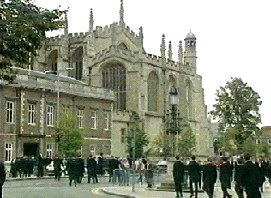
The decision of Henry VI - who was only eighteen at the time - to establish what we now know as Eton College, inspired patrons across the country to endow more schools. Unfortunately, the number of endowments declined later in the century, partly because of 'the shadows that fell over Henry VI's reign from 1450 onwards' (Orme 2006:236); partly because Henry was deposed in 1461, depriving the country of 'a champion of schools'; and partly because the Wars of the Roses between 1459 and 1485 'may well have distracted or deterred some other potential founders' (Orme 2006:236).
Eton 'was a close copy of Winchester but on an even grander scale' (Lawson and Silver 1973:47). Its foundation charter (dated 11 October 1440) provided for eleven priests, four clerks and six choristers; an almshouse for twenty-five poor men; and a school where twenty-five poor scholars would receive board, lodging and teaching. 'The master was to be paid a stipend to teach grammar not only to the scholars but to anyone else in England, without charge' (Orme 2006:232).
A year later, in February 1441, Henry issued a foundation charter for a Cambridge college (now known as King's) to be supplied with scholars from Eton.
In July 1441 he visited Winchester College, where he was 'so impressed by its headmaster, William Waynflete, that he immediately recruited him to be provost or chief officer of Eton' (Orme 2006:233). He also revised the Eton statutes to make the school even more like Winchester:
Ten chaplains were added to the staff of the chapel, the clerks were raised from four to ten, and the choristers from six to sixteen. The school was increased to the size of Winchester, with seventy scholars and an usher to help the master (Orme 2006:233).
As at Winchester, places were to be given first to boys from the parishes in which the two royal colleges were situated; second to boys from particular counties; and third to boys from anywhere else in the kingdom. The school was to be open to all comers without charge. 'Up to twenty sons of the nobility or sons or friends or the college could board in the college at their own expense, and a further thirteen poor pupils were offered food and clothing in return for acting as servants' (Orme 2006:233).
Unfortunately, Eton's promising start 'had a troubled sequel' (Orme 2006:234). When Henry was deposed in 1461, the Yorkist Edward IV granted much of the school's property to the nearby college of St George in Windsor Castle. As a result, the school's revenues fell sharply, the number of scholars had to be reduced, and the stipends of the teaching staff were cut by a third.
However, efforts were made by the college and its supporters to win Edward's favour, with the result that some of its old endowments were restored. The accession of Henry VII in 1485 assured the continuity of the college, but 'the damage of the previous twenty-four years was felt for some time afterwards' (Orme 2006:235):
The masters' salaries remained less than the founder had intended, and it has been doubted whether there was a full complement of scholars even in the early sixteenth century. Still Eton remains an impressive foundation, standing supreme with Winchester in wealth and resources above all other grammar schools of the fourteenth and fifteenth centuries (Orme 2006:235).
The teachers
For centuries, teaching had been provided by priests and monks, and it was not seen as a profession in its own right. There were men regarded as 'schoolmasters', but even they were mostly priests whose main job was teaching.
This began to change in the fifteenth century as more laymen took up teaching, though many schools still preferred to employ priests as teachers, often because of the nature of endowments linked to churches and chantries.
Some of the larger endowed schools, however, were 'more relaxed about whether they employed priests or laymen' (Orme 2006:173). Winchester College's statutes did not mention the subject, and Eton's required only that the master and usher should not be married - indeed 'the latter was forbidden to be in holy orders' (Orme 2006:173). At St Paul's School in London, founder John Colet was indifferent as to whether the master was married, single, or in orders, 'provided he was a good Latinist' (Orme 2006:173).
Schools began to seek graduates as teachers. From around 1450 Winchester and Eton were 'normally staffed by graduate masters and sometimes by graduate ushers' (Orme 2006:171). Other leading schools - including Magdalen College School in Oxford and St Paul's in London - did not insist on the appointment of graduates but 'routinely employed them' (Orme 2006:171). Some of the smaller provincial grammar schools, such as Sevenoaks and Wye, required their masters to hold degrees.
Before the sixteenth century, then, the status of the schoolmaster was not great. People knew their local teacher, of course, and sometimes addressed him as 'Master', a term of respect. But
teaching had little impact on the public imagination, and the public at all its levels thought little of teachers ... neither the Church nor the crown paid much attention to schools until the Reformation (Orme 2006:184).
The teaching
Any improvements in teaching in the fifteenth century tended to 'underpin the prevailing studies and outlook rather than to initiate any new departure' (Simon 1966:52). There was no sign yet of what was becoming known as the 'new learning', which involved critical and historical studies of the scriptures and of patristic writers. 'The first acquaintance with this outlook came in 1497 when John Colet returned from Italy to lecture at Oxford on the Pauline epistles' (Simon 1966:53).
Classroom work 'involved plenty of oral interchange' (Orme 2006:148). Pupils were taught not just to read and write Latin, but to speak it. Younger pupils were taught in English, but lessons for older pupils were conducted entirely in Latin. Indeed, anecdotal evidence suggests that
in the best schools, pupils who had passed beyond the elementary stages were required to speak Latin alone on school premises, whether they were in a lesson or not. Beckington's statutes for the choristers of Wells Cathedral laid down that, when at dinner or supper, they should 'ask for anything they want in Latin, not in English'. In 1484 the grammar master of Southwell Minster was charged with letting his boys speak English, not Latin, in school, and Magdalen College School insisted on Latin speaking in the 1490s (Orme 2006:148).
And while English had now become a textbook language, advanced works of grammar, such as the Doctrinale, remained wholly in Latin.
Although much of the teaching was oral, the invention of printing enabled books to be used more widely. The first grammar textbooks to be printed in England were produced at Oxford in the 1480s, and by the 1490s
the rival London presses of Wynkyn de Worde and Richard Pynson were both busy issuing small and low-priced texts: versions of the Accidence and Parvula, the Synonyma and Equivoca, the Hymnal, and Theodulus (Orme 2006:155).
Other books were imported from the Continent. The first school known to have had printed schoolbooks was Wells in 1498, and by the 1520s copies of the elementary grammars of Stanbridge and Whittington could be purchased from Dorne, the Oxford bookseller, for 1d. or 2d. each (Orme 2006:155).
Punishment
It had long been common for boys to be beaten or flogged if they misbehaved or failed to work hard enough. Few voices had been raised against the practice - Dunstan, in the tenth century, being a notable exception.
But attitudes were beginning to change, albeit slowly. In 1440 William Wykeham, the founder of Winchester College, instructed the schoolmaster to punish his pupils in moderation - advice which was repeated in the statutes of Eton.
The Bishop of Bath and Wells, Thomas Beckington, an alumnus of Winchester College, went further in his statutes for the choristers of Wells Cathedral in 1460. Boys who refused to learn their lessons, he said, ought 'first to be warned kindly, secondly if they neglect these warnings, sharply to be rebuked'. Only for third offences should they be flogged (Orme 2006:146).
This more humane approach was inherited by the humanists who became influential in sixteenth-century England:
Erasmus and Vives, like Beckington, believed that advice and then warnings should precede the use of physical punishment, which they considered only as a last resort. Vives thought that it could not be dispensed with entirely, but Erasmus, although he sanctioned it, admitted in his heart that he disliked its use (Orme 2006:146).
Chivalric training and apprenticeships
Medieval education, says Orme, 'should not be thought of simply in terms of officially recognised schools and endowed foundations' (Orme 2006:251). There was a great deal of private teaching, even in towns which had well-established schools; some of the schools of the religious houses admitted members of the public; and there was a growing number and range of apprenticeships.
There were also the great households of the king and the upper classes, which had been 'centres of education since Anglo-Saxon times' (Orme 2006:251). Here, the traditional form of 'chivalric' training continued to be popular. In the 1460s, ordinances issued for Edward IV's household stated that:
It was the duty of the master of the henchmen to teach young men to ride, joust and wear armour and to instruct them in the formalities of courtly tenure and household service, with particular attention to their manners at table. They were also to be taught 'sundry languages and other learnings virtuous, to harping, to pipe, sing, dance', while each should practise 'that thing of virtue that he shall be most apt to, with remembrance daily of God's service accustomed' (Myers 1959:126-7, quoted in Simon 1966:10).
By the fifteenth century various groups had begun establishing systems of education, mostly linked to professions or trades. Training for common lawyers, for example, was being developed at the Inns of Court and Lesser Inns of Chancery, situated between the king's courts at Westminster and the City of London (Simon 1966:8).
In fact, 'It would be altogether wrong to think of medieval education mainly in terms of schools and universities' (Lawson and Silver 1973:72). Most people were educated through their employment:
Personal service was the cement that bound medieval society together - most men owed service to a superior in return for a consideration of some sort, and apprenticeship meant personal service in return for instruction. In a sense all medieval education was technical and vocational, directed to some particular occupation or function, and apprenticeship was the form it normally took (Lawson and Silver 1973:73).
In London, the 'better trades' established a form of apprenticeship in service under guild supervision. The training of apprentices, like that of the upper classes, 'was concerned with manners and morals as well as instruction in the relevant skills' (Simon 1966:9). Such schemes spread gradually to provincial towns, and by the fifteenth century entrants to these trades were expected to have a reasonable standard of education. By 1478 the Goldsmiths' Company, for example, had a rule that no apprentice be taken 'without he can write and read' (quoted in Simon 1966:15). The effect of such rules was to stimulate demand for 'a more effective schooling than that obtainable from parish clerk or chantry priest' (Simon 1966:15).
However, the very poorest in society - the serfs - were prevented by law from obtaining apprenticeships. The 1406 Statute of Apprentices sought 'to control the movement of labour from the countryside by re-enacting earlier legislation forbidding people to apprentice their children in towns unless they owned land to the value of at least 20s. a year' (Orme 2006:221).
There were cases of boys being sent to school without permission at Barton in Bedfordshire in 1410, Great Badminton in Gloucestershire in 1416-7, and Methley in Yorkshire in 1465. Fines and other penalties were imposed.
Even in the sixteenth century, manorial courts were being told to ask 'if there be any bondman of blood that putteth his son unto the school to make him a priest or a prentice' (quoted in Orme 2006:221):
The last such treatise was published as late as 1552, when serfdom itself was all but dead. There was no 'emancipation of the serfs' in terms of education; the restriction died only when serfdom died, itself never formally ended (Orme 2006:221-2).
The universities
Expansion
In addition to his new school at Winchester, in 1379 William Wykeham established New College Oxford, declaring that his aim was to help 'cure that general disease of the clerical army ... grievously wounded owing to the fewness of the clergy, arising from pestilences, wars and other miseries of the world' (quoted in Lawson and Silver 1973:55).
Like Winchester, New College was 'a striking innovation' (Lawson and Silver 1973:55). It provided for a warden and seventy fellows, recruited exclusively from Winchester, with a staff of chaplains, clerks and choristers. It was by far the largest college in either university, and its chapel, hall and chambers round an enclosed quadrangle 'were the first complete purpose-designed college buildings' (Lawson and Silver 1973:55). It became a model for other colleges.
Its primary function was to support undergraduates through the arts course. The juniors attended the university schools, and in their first two years they were taught by their college seniors.
New College effectively doubled the number of students in the Oxford colleges, but the total was still 'hardly a tenth of the members of the university as a whole' (Lawson and Silver 1973:55).
Students usually entered university around the age of fourteen, some younger, some older. Most of them would be intent on a clerical career, though 'from the fifteenth century there was a well-born minority who apparently had no serious vocational motive and were there for only a year or two in order to finish off their education' (Lawson and Silver 1973:56).
During the arts course, most students were supported financially by parents or patrons. Poor scholars were allowed to beg, provided they carried a licence from the Chancellor, but many were forced to leave without graduating because of insufficient means.
More advanced scholars sought the support of a benefice, but towards the end of the fourteenth century the availability of these had been drastically reduced and 'a crisis of student maintenance and graduate employment faced the universities' (Lawson and Silver 1973:58). As a result, the number of students had declined: in 1400, Oxford had around 1,200, Cambridge about 400.
To ease the problem of maintenance 'and for reasons of piety and philanthropy or calculated self-interest' (Lawson and Silver 1973:58) Henry VI and various clerics founded new colleges: Lincoln (1427), All Souls (1438) and Magdalen (1448) at Oxford; and God's-house (1439), King's (1441) and Queens' (1447) at Cambridge.
With the help of benefactors, older colleges added new buildings and accumulated libraries - in 1418 Peterhouse had 380 books. Some colleges sought to increase their revenues by admitting a few commensales (commoners) as paying guests - up to twenty of these were allowed by the statutes of Magdalen College issued in 1480 - 'an important innovation pointing to future developments' (Lawson and Silver 1973:59).
Meanwhile, the universities themselves were 'chronically poor'. They owned little or no corporate property; lecture rooms ('schools') were still rented, and churches and friaries were used for meetings and ceremonies.
However, Oxford built a divinity school to house the library which Duke Humphrey of Gloucester gave between 1435 and 1447, and Cambridge created a schools' quadrangle with a regent house and library (which had 330 books in 1474). Both projects took many years to complete.
Collectively, even individually, the colleges were far wealthier than the university of which they formed only a part. King's College, Cambridge, had a revenue of over £1,000 in 1460, when the annual income of Oxford University averaged about £58. The university's standing in relation to its colleges was eventually bound to suffer (Lawson and Silver 1973:59).
From around 1480 the universities (and the grammar schools) benefited from an increase in educational philanthropy and endowment. As a result, two new Cambridge colleges opened: St Catharine's (1473) and Jesus (1496).
Meanwhile in Scotland three universities were founded in the fifteenth century: St Andrews in 1413, Glasgow in 1451 and Aberdeen in 1495. Edinburgh would follow in 1582.
The curriculum
The university curriculum had changed little since the thirteenth century: 'the seven liberal arts and the three philosophies of Aristotle remained the staple' (Lawson and Silver 1973:59).
In an effort to halt the decline in the teaching of grammar, a master's degree in the subject had been introduced, probably in the late fourteenth century. However, grammar had 'relatively little prestige: it had only a quasi-faculty status and its masters did not sit in the congregation of regents' (Lawson and Silver 1973:59).
Logic became less attractive and scholasticism 'was running to seed' (Lawson and Silver 1973:60).
Nevertheless, in the course of three centuries logic had contributed enormously to the progress of civilization, elevating intellectual discipline, reason, order and system, if also fostering a spirit of contentiousness, a preference for abstractions and merely verbal formulas divorced from life, nature and history (Lawson and Silver 1973:60).
The growing interest in humanism hastened the decline in the teaching of logic but helped to restore the study of grammar - now with a literary rather than a linguistic emphasis. 'Classical literature, stimulated by the recovery and critical study of ancient texts, attracted increasing attention, even though it formed no part of the official curriculum' (Lawson and Silver 1973:60).
By the 1480s humanism had reached both universities. Greek studies were added in the early 1500s, and music by the middle of the century. However, 'music was not highly esteemed academically and produced few graduates' (Lawson and Silver 1973:60).
Of the higher faculties, civil and canon law attracted most candidates, no doubt because they offered the best prospects for a profitable career. Theology attracted mainly monks and friars, while medicine was still poorly regarded. In 1421 university physicians petitioned parliament to prevent non-graduates from practising medicine, 'but only a minority of medical men can ever have had degrees: the majority were trained no doubt by apprenticeship, some study of standard authorities, and practice' (Lawson and Silver 1973:60).
Falling numbers and poor organisation threatened the higher faculties with extinction. 'Even the few men who studied in them easily gained dispensation from the statutory requirements which made the courses so long and arduous' (Lawson and Silver 1973:60).
Discipline
Some scholars still lived in private lodgings and it was these 'chamberdeacons' whose freedom from supervision sometimes 'made for rowdyism and indiscipline' (Lawson and Silver 1973:55).
To try to deal with this problem, the universities repeatedly banned students from lodging in private houses and set up halls (at Oxford) or hostels (at Cambridge). These became the normal places of residence for undergraduates.
Each was conducted by a principal, who was usually a regent master, duly approved and regulated by the university. He leased the house (often from monastic or college landlords), charged his students a room rent and paid a manciple or steward to do the catering. Instruction was also provided for a fee, supplementing the public lectures in the schools (Lawson and Silver 1973:56).
Discipline became stricter with the enforcement of residence. Among the banned activities were 'the keeping of dogs or hawks, sword-and-buckler play, dice, draughts and chess, wrestling or dancing in hall and ball games in chapel' (Lawson and Silver 1973:56). For undergraduates, fines and flogging were common punishments.
Despite these restrictions, violence between the 'nations', or rival halls, or between students and townsmen continued to be a problem. In 1432 an Oxford statute set an elaborate tariff of fines to combat brawling and fighting,
but lawlessness was endemic and incurable - the normal state of society. As late as 1506 a battle between northerners and southerners outside the university church led to the deaths of a college fellow, the principal of a hall and two undergraduates (Lawson and Silver 1973:58).
Preparing for change
Joan Simon argues that
there were no spectacular developments in fifteenth-century England comparable to those in the city states of the Italian peninsula, but there was a slow maturing of change in institutions and attitudes which laid the foundation for a durable advance in the next century (Simon 1966:56).
Many more lay people were now literate and there was a growing demand for regular schooling. In addition, English superseded Latin and French as the language of law and business. 'Eventually what had been the dialect of the south-eastern region, where both court and capital were situated and the great vernacular writers originated, became transformed into the King's English' (Simon 1966:19).
The slow but steady expansion of lay education was given an enormous boost by the invention of printing. In 1476 William Caxton (c1415-1492) returned to England from the Continent and set up a printing press in Westminster.
The printed book ... heralded a revolution in education and self-education. Not only could there be serious and sustained textual study, in place of the prevailing oral teaching, but a vastly increased range of subject matter became available to scholars, in relatively accurate form by comparison with the vagaries of scriveners (Simon 1966:56).
These developments clearly had profound implications for the church, which for centuries had been virtually the sole provider of education. It also faced a number of other challenges:
the development of philosophy, medicine, and law had the effect of removing parts of the educational system from the direct supervision of the Church, and the universities' fight for their independence, as corporate learned bodies deciding their own conditions for granting degrees and hence licences to teach, was to an important extent successful (Williams 1961:131).
Attempts to break the ecclesiastical monopoly were 'one aspect of a wider conflict, endemic for many years, which came to a head at the Reformation' (Simon 1966:21).
But for the moment, England lagged way behind other European countries, where the Renaissance was stimulating renewed interest in literacy and learning. By the end of the fifteenth century England had printing presses in just four cities, compared with 73 in Italy and 50 in Germany. The humanist ideas of reformers like Erasmus and Vives in northern Europe were barely heard of in England until Erasmus visited London in 1499. He returned a few years later to assist John Colet in setting up a new St Paul's school in London to be run on humanist lines:
Here was a public school of the kind that all humanist writers advocated: a school open to all comers, placed in the city and not shut away in a monastic precinct, held in a building of its own and under the control of a public authority (Simon 1966:73).